


Custom machinery & contract manufacturing
Enquiry, costing, service job, documentation
The bottleneck is rarely in production. It sits in the quotation phase, in the spare parts business, and in the documentation that gets caught up on at the end of every project. That is exactly where we start. We mean manufacturers with their own service arm and 10 to 100 employees, not the group with its own IT department.
Enquiries become usable data
PDF, spreadsheet and email text turn into a record you can actually cost.
Quotes in hours
A draft with line items and a rough bill of materials, instead of a week of waiting.
Spare parts without back-and-forth
Machine number, year of build, installed parts: the follow-up email disappears.
From the workshop
A finished application, not a concept paper
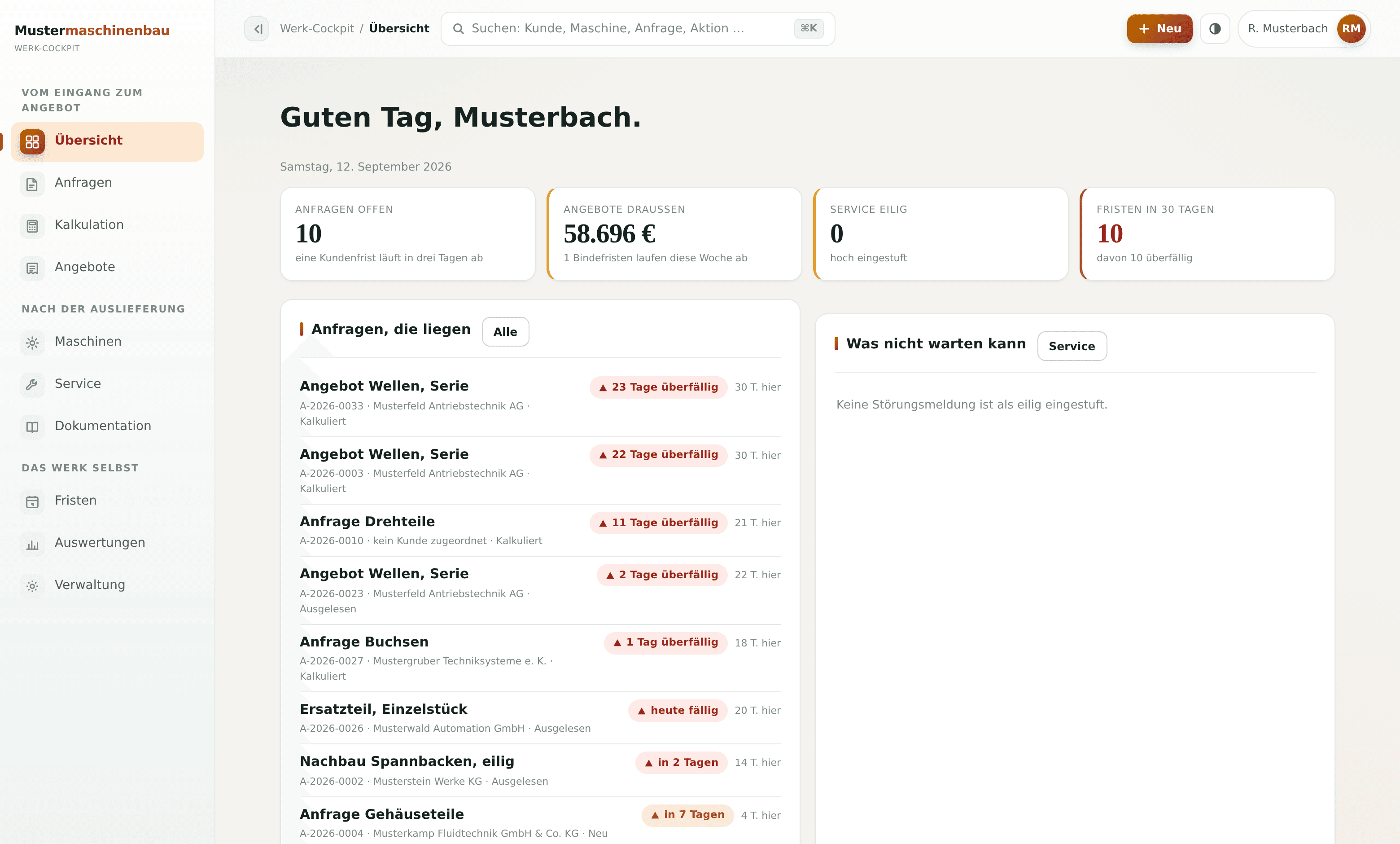
The Werk-Cockpit is a browser application we built and that you can look at. An incoming enquiry becomes line items with quantity, material, tolerance and date — and next to every value sits the place in the original it came from. The costing shows what set-up time does to the unit price and warns where an operation is missing from the price. After delivery it assigns the fault report to the machine and works out whether the case is still under warranty. It replaces no ERP and no CAD data. It sits in front of them and produces the things that were in no program before.
Technology
Next.js, PostgreSQL and Docker, in containers on a machine in your works or on your own server. The three calculation cores — tolerances per ISO 286, the costing, and the deadlines under the German Civil Code, Commercial Code and Machinery Regulation — are pure computation without database and without network. That is why they can be tested individually, and each has a test suite whose expectations were recalculated by hand from the standard. The public holiday calendar is set to Baden-Württemberg; public holidays are a matter for the individual states.
About the screenshots
The screenshots come from a demo installation of an invented “Mustermaschinenbau”. Every customer, drawing number, machine, price and costing rate shown is invented, and recognisably so: company names are exclusively “Muster…” placeholders. We do not show real customer data or real costings, not even on request. The evaluation of the enquiries is not written into the demo data but computed by the rule set — what appears in the picture is what the application produces.
We will demonstrate the application in 20 minutes, on invented data and without obligation.
Arrange a demonstrationBuilt to fit
Built for your case, not off the shelf
We do not sell finished software. Every application you see on these pages was built for one single business, and it would look different at yours, because your workflows, your programs and your responsibilities are different. We build every solution around your use case, and the template for it is your business.
Your workflow sets the shape.
We reproduce the way you already work instead of teaching you the workflow of somebody else's software.
Your words, your forms.
Labels, fields, templates and printouts come from your house. Nobody has to learn what a generic screen is supposed to mean.
What you do not need, we do not build.
No feature set you pay for and nobody opens. The cut comes from your workflow, not from a price list.
Workflows
What we take over
Five workflows between enquiry and acceptance. None of them interferes with your engineering or your production control.
Enquiries and tenders become readable
The relevant specifications are extracted from the incoming enquiry (PDF, spreadsheet, email text, drawing set): quantities, materials, tolerances, dates, standards. The result is a record in your structure, with a visible reference back to the source.
Today
Two hours of reading and retyping before any costing happens.
Afterwards
A structured enquiry record with source references, to review rather than retype.
From enquiry text to costing template
The enquiry record, comparable past orders and your pricing structures produce a draft quote with line items and a rough bill of materials. The costing stays with your estimator. We hand them the template filled in rather than blank.
Today
The design engineer writes quotes instead of designing.
Afterwards
The draft exists; the technical review takes minutes instead of hours.
Service jobs and spare parts without back-and-forth
A fault report is matched to the machine, the year of build and the installed configuration, even when the customer only writes 'the line in hall 2 is down'. The right spare part is proposed, the quote prepared, the service appointment scheduled.
Today
Three emails back and forth just to establish which machine is meant.
Afterwards
The report is matched to a machine and a part on first contact.
Technical documentation that grows with the project
Operating manuals, test reports, acceptance protocols and conformity documents are built from what the project produces anyway, instead of from memory after delivery. Modules that repeat across machines are reused rather than rewritten.
Today
Documentation is written three weeks after delivery, under time pressure.
Afterwards
The paperwork grows with the project and is complete at acceptance.
Stock control, design data and the inbox talk to each other
Inventory management, design data, time tracking and the inbox know the same orders but exchange nothing. We build the connections in between. Where your programs provide a route for that, we take it. Where they do not, we take the path an employee would.
Today
The same order number is copy-pasted through three systems.
Afterwards
One order, one data set, identical everywhere.
More workflows
Everything that runs alongside enquiry and order
The workflows above cost the most time. Alongside them, every shop runs a list of smaller routines that come back just as reliably every week. We automate them to the same pattern: the work is prepared, you approve it.
Enquiry and quotation
- Line items from the enquiry
- Quantity, material, tolerance, standard and date are read out, with the place in the original next to each. To check rather than to retype.
- Costing
- Set-up time, quantity breaks and unit price belong together and are calculated together. If an operation is missing from the price, it warns instead of rounding.
- Draft quotation
- From the line items and your own rates a draft arises in your template. The draft is the starting point of your review, not a substitute for it.
- Chasing quotations
- Quotations nobody answered report back after the agreed time, with the state of play, the contact and what was last discussed.
Machine and service
- Machine file
- Drawings, serial numbers, acceptances and jobs hang on the machine, years after delivery as well.
- Warranty
- A fault report is assigned to the machine and it is worked out whether the case is still under warranty. With the calculation, not from the gut.
- Service job
- The report becomes a job with a date, a spare part and an owner. What was fitted then sits in the machine file.
- Deadlines with the calculation
- Delivery date, acceptance period, end of warranty: calculated rather than estimated, each with the rule it comes from.
Documentation and connections
- Documentation
- The documentation arises with the project, not after it. What is missing sits in a list while people still have it in their heads.
- Filing with readable names
- Every document lands in that project's folder, named to the same pattern, whether it comes from mail, the scanner or the shop floor.
- Connected to your programs
- Bills of material, articles and dates come from where they are kept: ERP, CAD, time tracking. Nothing is replaced.
- Reports
- Quotation hit rate, capacity, open claims. Every figure is also a filter: one click leads into the list behind it.
This is not a list to tick off and not a package you order. Hardly any business needs all of it, and nobody starts with everything: we take the two or three workflows that cost you the most time, the rest comes later or not at all.
Approvals
What stays with you
We automate the routes between your systems, not your technical decisions. What a customer receives and at what price is still decided by people in your company.
- Quotes, bills of materials and prices only go out after technical review.
- Design and production data stay in your systems and on your network.
- On request the language model runs on-premise. That matters when customer drawings are under a confidentiality agreement.
- Every automated step is traceable and can be switched off without bringing the workflow to a halt.
Your own software
When your ERP advertises AI
ERP vendors are catching up: recognising enquiries, suggesting text, searching documents. Usually it is covered by the maintenance contract. But in the quoting phase, which is the actual bottleneck, what decides is not the quality of the prose but the working behind the number. Here is when that is enough.
Then it is enough
- It is about searching a document or suggesting the wording of a cover letter.
- Your costing runs in a spreadsheet you know and trust, and that is how it should stay.
- Enquiries arrive in manageable numbers and through one channel.
- Documentation at the end of a project is handled by one person who knows every project.
Then it is not
- The costing has to show the full working: setup share, machining, material including offcut, bought-in work, overhead, margin.
- Batch size degression has to be right. Setup time is incurred once per batch and not per piece, which is why the same part costs a multiple at five pieces of what it costs at a hundred. Every flat estimate fails exactly here.
- The material has to enter as a time factor (1.4301 roughly twice the machining time of S235JR), not as a material price alone.
- It has to warn you when an operation is missing from the price instead of producing a plausible number. A costing that never objects is no help.
- Matching incoming enquiries to the right customer has to be measurable, with a hit rate you can check.
If this list leaves you with the module your software already ships, that is a good outcome: you just saved yourself a purchase. The free check answers exactly this question in 45 minutes, before anyone writes a quote.
Objections
What you are asking yourself now
- Do we have to switch software?
- No. We replace nothing. Your stock control, your design data and your filing stay exactly where they are. We build the connection in between.
- We have nobody for IT.
- You do not need one. We set it up and we look after it. At your end it is operated by someone who used to operate Excel.
- What happens when the automation fails?
- Then the workflow carries on as before, by hand. We build nothing whose failure brings your operation to a halt.
- Does our data go into a cloud?
- Only if you want it to. Otherwise everything runs on a machine in your own works or on a server of your own.
- And if it does not pay off for us?
- Then we say so in the check, before any quote. That is why the check is free.
Effort & timeline
One workflow, a few weeks
We start with one workflow, usually the quotation phase, because that is where the waiting time sits and where the effect is immediately visible. Which one it is for you follows from the free check. The first goes live four to six weeks after you give the go-ahead.
Let's take your last ten enquiries and run the numbers.
45 minutes, free of charge, by video or at your plant. We look at how much time passes between an enquiry arriving and a quote going out, and which part of that is identical every time. With or without working together afterwards.
Further reading
If you want to go deeper
- ServiceDocument intelligenceHow a drawing set, a tender and a spreadsheet become a record you can cost.
- ServiceAI agents & automationWhat can run unattended between enquiry, quote and service job.
- Use caseAI knowledge assistantHow earlier costings, drawings and service reports become findable the moment the next enquiry comes in.