


Engineering & planning practices
Project, tender, deadline, variation
For architecture, building services, structural and planning practices where the professional work hangs on the document load. Two-hundred-page tenders, minutes after every meeting, variations that surface too late. Those are the stretches we rebuild.
Tenders become searchable
Requirements, standards, deadlines and quantities extracted from the tender package.
Minutes without an evening
Notes and a recording become minutes with tasks and deadlines attached.
Variations surface
Deviations from the commissioned scope become visible while they still count.
From the workshop
A finished application, not a concept paper
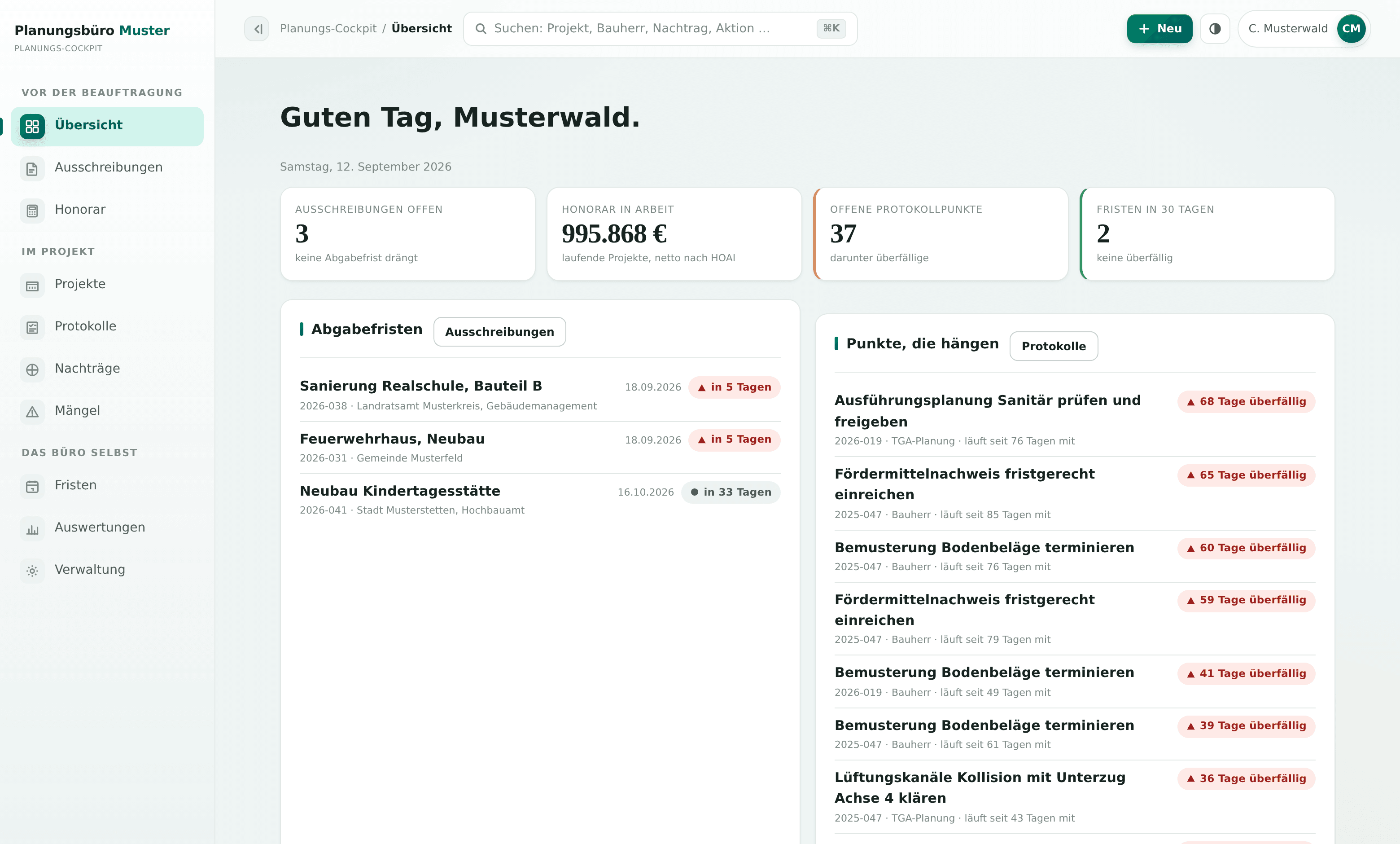
The Planungs-Cockpit is a browser application we built and that you can look at. It reads the key points out of a tender package and puts the page number next to every entry. It calculates the fee under the German scale of fees for architects and engineers, including the interpolation between two table rows that most often goes wrong by hand. Minute items carry forward across meetings and keep their origin. And for a variation it checks the conditions set out in the statute and in the German construction contract procedures — it decides nothing, but it asks the question in time rather than at the final account.
Technology
Next.js, PostgreSQL and Docker, in containers on a machine in your office or on your own server. The four calculation cores — the fee scale, procurement and construction contract deadlines, the tender package evaluation and the variation check — are pure computation without database and without network. That is why they can be tested individually, and each has a test suite whose expectations were recalculated by hand from the fee table and against a calendar. The public holiday calendar is set to Baden-Württemberg. The application is a calculation aid; it replaces neither the review of the tender documents nor the legal assessment of a variation.
About the screenshots
The screenshots come from a demo installation of an invented “Planungsbüro Muster”. Every client, contracting authority, project, fee and variation shown is invented, and recognisably so: names are exclusively “Muster…” placeholders. We do not show real project data, not even on request. The evaluation of the tender packages is not written into the demo data but computed by the rule set — what appears in the picture is what the application produces.
We will demonstrate the application in 20 minutes, on invented data and without obligation.
Arrange a demonstrationBuilt to fit
Built for your case, not off the shelf
We do not sell finished software. Every application you see on these pages was built for one single business, and it would look different at yours, because your workflows, your programs and your responsibilities are different. We build every solution around your use case, and the template for it is your business.
Your workflow sets the shape.
We reproduce the way you already work instead of teaching you the workflow of somebody else's software.
Your words, your forms.
Labels, fields, templates and printouts come from your house. Nobody has to learn what a generic screen is supposed to mean.
What you do not need, we do not build.
No feature set you pay for and nobody opens. The cut comes from your workflow, not from a price list.
Workflows
What we take over
Five workflows between tender and handover. The professional planning stays entirely with you.
Making tenders and specifications searchable
The key points are extracted from the tender package: scope, deadlines, required evidence, standards, quantities and special conditions, each with a reference to where it was found. You can see in minutes whether bidding is worthwhile, instead of in hours.
Today
Reading two hundred pages to make a yes-or-no decision.
Afterwards
A compiled summary with source references that the decision is made from.
From specification to fee proposal
The captured scope, comparable projects and your own rates produce a draft proposal, under the German fee scale or your own costing. The draft is the starting point for your review, not a replacement for it.
Today
Every proposal is copied from the last one and painstakingly adjusted.
Afterwards
The draft exists with items and rates; the review stays professional.
Deadlines and variations in view
Submission dates, review periods, approval windows and contractual deadlines run as records with lead time. Requirements going beyond the commissioned scope are recognised and flagged as a possible variation while it can still be claimed.
Today
Variations surface once they can no longer be claimed.
Afterwards
Deviations appear as a flag, with a reference to the contract text.
Minutes, site diary and defect lists
Notes, a voice recording and photos become minutes in your own template, with decisions, responsibilities and dates. Defects are tracked as a list with photos and location and are automatically presented again at the next meeting.
Today
Minutes written in the evening from memory, the defect list in a spreadsheet.
Afterwards
Minutes ready for review the same day, tasks with dates attached.
Connecting project filing, tendering software and accounting
Project filing, tendering software, time tracking and accounting know the same projects but not each other. We build the connections so a project status can be read without searching in four systems.
Today
Project status is established by asking three colleagues.
Afterwards
One look at the project is enough: hours, costs, open items, deadlines.
More workflows
Everything that runs alongside the project
The workflows above cost the most time. Alongside them, every practice runs a list of smaller routines that come back just as reliably every week. We automate them to the same pattern: the work is prepared, you approve it.
Tender and fee
- Key points from the tender package
- Scope, deadlines, required proofs, standards and quantities are read out, every entry with its page number. In minutes instead of hours.
- Minimum periods
- Whether the tender period meets the statutory minimum is calculated rather than eyeballed, with the provision next to it.
- Fee under HOAI
- Chargeable costs, zone, table value and the interpolation between two rows that most often goes wrong by hand.
- Work stages
- What has been delivered and invoiced in which stage runs along. Interim accounts arise from the record, not from memory.
Project and dates
- Project file
- Parties, contracts, drawings, minutes and open points in one place, even when three practices work on the same project.
- Minutes
- Items carry forward across meetings and keep their origin. What is open stays visible until it is done.
- Dates and deadlines
- Submission, objection, review period, acceptance: calculated from the rule, with an early warning date and an owner.
- Defects
- Every defect with location, photo, responsible party and date. The follow-up keeps itself, instead of ageing in a spreadsheet.
Variations and figures
- Checking variations
- The conditions from the statute and the German construction contract procedures are checked and the question asked in time, not at the final account. The practice decides.
- Filing with readable names
- Every document lands in that project's folder, named to the same pattern, whether it comes from mail, the scanner or the platform.
- Connected to your programs
- Tendering software, accounting and the clients' own platforms are connected, so the same entry is not typed three times.
- Reports
- Win rate, hours against fee, open variations. Every figure is also a filter: one click leads into the list behind it.
This is not a list to tick off and not a package you order. Hardly any business needs all of it, and nobody starts with everything: we take the two or three workflows that cost you the most time, the rest comes later or not at all.
Approvals
What stays with you
Planning, dimensioning and the professional assessment of a situation stay entirely with you. We automate the routes there and back.
- No dimensioning, no structural verification, no planning decision made by the system.
- Proposals, minutes and variations only go out after your review.
- Every extraction from a tender package points back to its source: verifiable rather than asserted.
- Project and client data stay in your systems; on request the model runs in your own building.
Your own software
When your planning software offers AI
Tendering and project software now advertises AI features for specification text and document search. For working through 200 pages that genuinely helps. For fees and variations what decides instead is whether the number can be evidenced. Here is where the line runs.
Then it is enough
- 200 pages of tender documents need searching, and somebody checks the hits anyway.
- You calculate fees with a table you have maintained for years.
- Variations are rare one-offs at your office, checked personally by the project lead.
- Deadlines hang off a few projects that all sit in the same calendar.
Then it is not
- The fee has to be calculated under HOAI 2021, with linear interpolation under section 13 and both reference points shown in the working.
- Outside the fee table there must be no extrapolation. A module that produces a number anyway is more dangerous than none at all.
- Every figure has to carry the note that, since the CJEU judgment of 04.07.2019 (C-377/17) and the 2021 amendment, the table values are guidance and not binding minimum rates.
- Variations have to be checked against VOB/B and BGB: section 2 (6) with notice before work starts, section 2 (3) above ten per cent quantity deviation, section 650b BGB with its thirty-day agreement period.
- Where quantities deviate, the new unit price applies only to the quantity above 110 per cent. That rule belongs in the application, not in the head of whoever is handling it.
If this list leaves you with the module your software already ships, that is a good outcome: you just saved yourself a purchase. The free check answers exactly this question in 45 minutes, before anyone writes a quote.
Objections
What you are asking yourself now
- Do we have to switch software?
- No. We replace nothing. Your tendering software, your project filing and your bookkeeping stay exactly where they are. We build the connection in between.
- We have nobody for IT.
- You do not need one. We set it up and we look after it. At your end it is operated by someone who used to operate Excel.
- What happens when the automation fails?
- Then the workflow carries on as before, by hand. We build nothing whose failure brings your practice to a halt.
- Does our data go into a cloud?
- Only if you want it to. Otherwise everything runs on a machine in your own office or on a server of your own.
- And if it does not pay off for us?
- Then we say so in the check, before any quote. That is why the check is free.
Effort & timeline
One workflow, a few weeks
We usually start with tender evaluation or with the minutes. Both repeat identically in every project. Which workflow it is for you follows from the free check. The first goes live four to six weeks after you give the go-ahead.
Let's use your last tender as the example.
45 minutes, free of charge, by video or at your office. We look at how many hours per project go into evaluation and minute-taking, and which part of that is identical every time. With or without working together afterwards.
Further reading